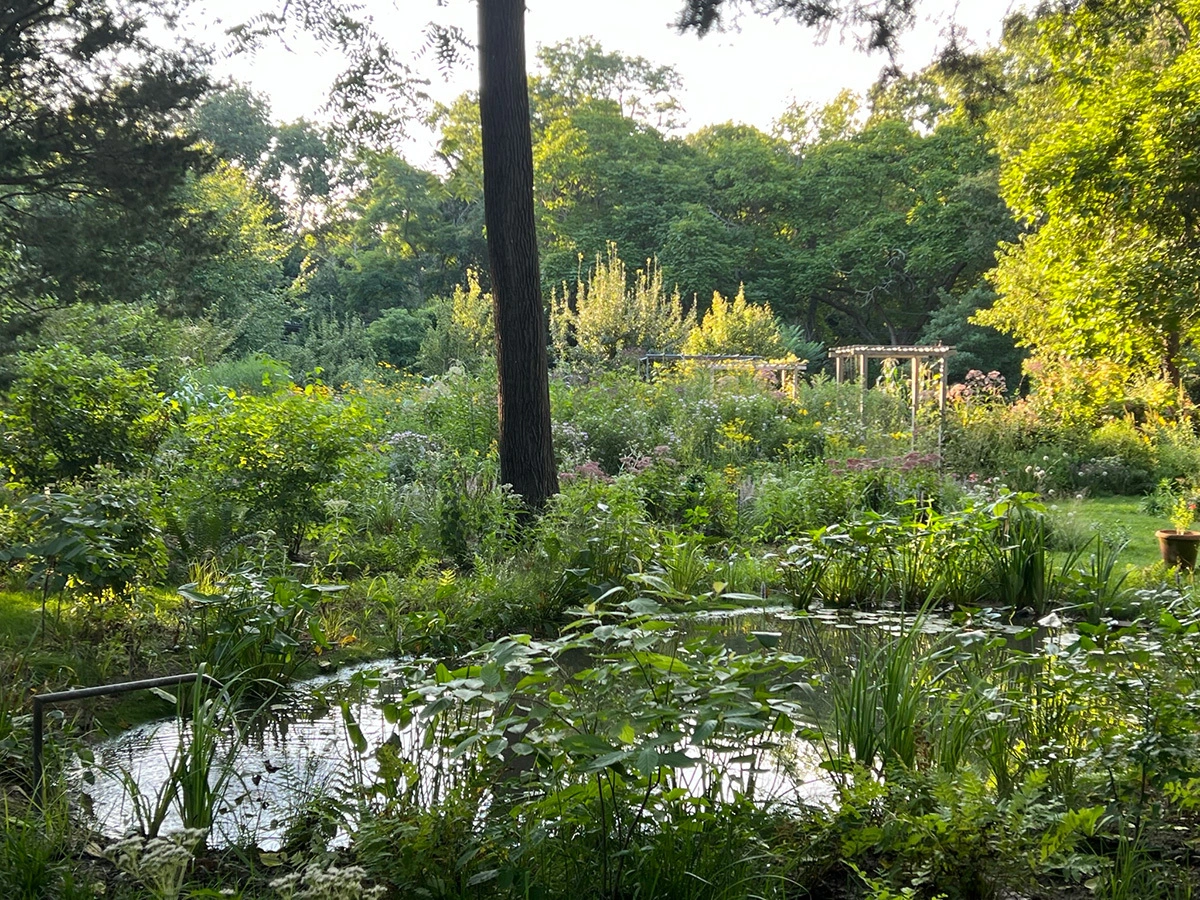
Marshouse
Edwina von Gal on following nature’s lead, celebrating nibbled leaves, and keeping a garden in the loop
Landscape designer and Perfect Earth Project founder Edwina von Gal is constantly experimenting in the garden at her East Hampton home. Marshouse is chemical-free, planted heavily with natives, and managed as a closed loop, where the biomass the landscape produces stays on site.
Ahead of Marshouse’s Garden Conservancy Open Day, we asked Edwina what the garden has taught her, why she created Nibbled Leaf, and what has her attention outside right now.
What has Marshouse taught you?
Marshouse is my home and my refuge. It has taught me to follow nature and let it be my guide. As the founder of Perfect Earth Project, I have made a commitment to support biodiversity, to explore ways to do it beautifully, and to engage others with the joy and fun of it. I am learning as I go. I never use chemicals and plant 2/3 for the birds (at least two out of every three plants I buy are native). My property is a closed loop: no biomass leaves and no inputs enter, just more plants. There is always something new I am trying out and something happening I didn’t expect: surprise successes and failures, a new bird or bee visitor, a native bloom I didn’t plant, the way the light hits a seed head.
Why did you create Nibbled Leaf?
Nibbled Leaf is about showcasing the beauty of nature-friendly gardens, the joy of sharing our properties with wildlife, and the significant contribution gardens and gardeners can make to the health of our planet. Perfect Earth Project hatched the idea with the Garden Conservancy in 2022 as a way to celebrate the many Open Days gardeners who are taking key steps to support the ecosystem and biodiversity, and to encourage more to take part.
What do you hope people take away from visiting a Nibbled Leaf garden?
I hope they’ll learn that you don’t need chemicals to make your garden beautiful, that there is beauty in letting go, and that they’ll celebrate when they see nibbled leaves. Those nibbled leaves are providing food for insects like caterpillars who become our pollinators and who also feed the birds and other wildlife we want (and need!) in our yards. I also hope people will leave inspired to minimize harm at home and maximize biodiversity, health, and joy!
Where should someone who wants a wilder garden begin?
Start by making three very simple PRFCT Promises to your land: avoid all chemicals (no pesticides or fertilizers), plant 2/3 for the birds (for every three plants you buy make two of them native), and close the loop (leave all biomass on site, bring nothing in and send nothing out, except more plants).
Why does nothing organic leave Marshouse?
The land gives us everything we need. In nature, nothing is waste and nothing goes to waste. Biomass goes back into the soil, right where it was born, to provide the perfect food for the plants that made it and to support millions! . . . billions! . . . trillions! of other lives as well. I compost and leave the leaves, and have fun with my biomass. I stack log walls from invasive trees, create habitat piles, wren tents, dead hedges, and weave leaf baskets from fallen branches to store autumn leaves. I make haystacks from meadow cuttings and leave dead trees (snags) standing for birds and insects. I’ve also built a hibernaculum for snakes from the soil dug up to build a clay-lined pond.
What’s buzzing, blooming, or exciting you at Marshouse right now?
The garden is looking quite full this year. The rudbeckia are thriving, the goldenrod and aster are doing their thing, and we are looking forward to the imminent fall color change of little bluestem grass.
Visit Marshouse on Wildr
See what’s growing at Marshouse, and follow along as the garden changes through the season.
See Marshouse on Wildr Places